
Mobilité internationale – Stage au Canada
Cet été, découvrez chaque semaine le portrait de nos étudiant.e.s de M1 qui sont actuellement en mobilité internationale.
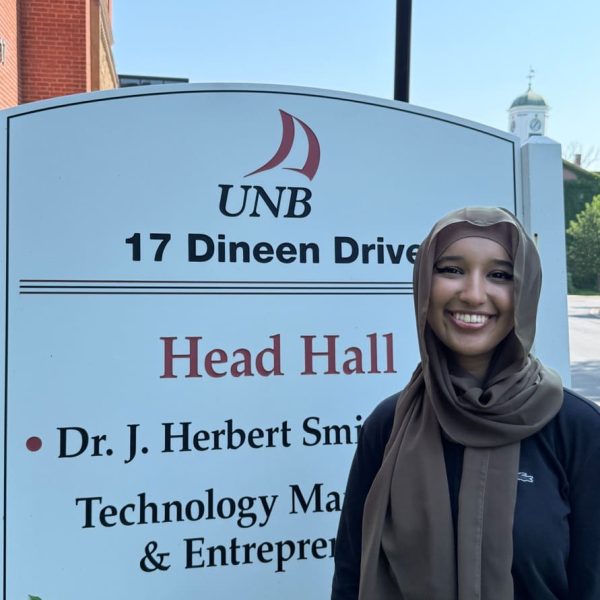
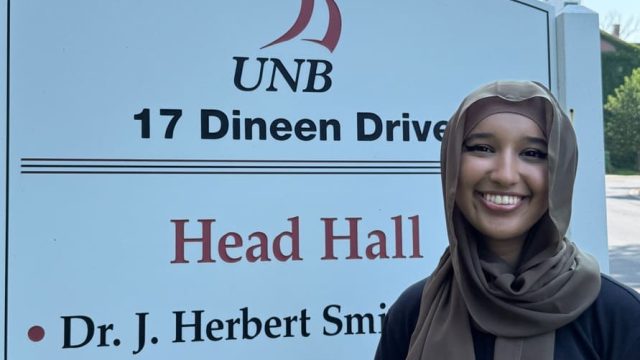
Aujourd’hui c’est Nihal, étudiante dans le parcours Advanced Ceramics qui fait sa mobilité à l’Université du Nouveau Brunswick (Canada).
1. What is your background?
I’m Nihal Basraoui, a Materials Science and Engineering graduate with a double diploma completed last year between France and Morocco. This program gave me a solid foundation in the design, processing, and characterization of materials, for both theoretical and applied aspects of materials from ceramics to metallurgy and polymers. Currently, I’m pursuing a Master’s degree in Materials Science at the University of Limoges in France.
My academic interests focus on advanced materials for aerospace and aeronautical applications, particularly high-entropy alloys, ceramic-metal composites, and thermal spray coatings. As part of my international mobility and research training, I’m currently doing a research internship in Canada. My work focuses on the development and analysis of high-entropy cermet powders for thermal spray applications, materials designed for use in demanding applications to withstand high temperature environments. This experience is strengthening my skills in powder metallurgy, materials design and expanding my technical knowledge.
2. International exchange is mandatory during the first-year Master’s program in TACTIC Grad School. Were you apprehensive about this exchange?
I wouldn’t say I was apprehensive, but rather curious and eager. I’ve always wanted to explore beyond my comfort zone, and the idea of going to Canada excited me to grow both personally and professionally. The chance to experience a different research methods, and collaborate internationally was very motivating. The team here welcomed me warmly, and with the guidance of my supervisor, I quickly felt like part of the group, which helped me adapt smoothly.
This experience is much more than just an internship or a short-term project to complete and move on from. It’s not just about completing tasks,it’s more about learning in depth, gaining hands-on experience, and truly understanding what it means to contribute to research. I see it as a valuable opportunity to grow, to refine my approach as a future researcher, and to start building a solid path toward a career I aspire to build in materials science.
3. How did the internship search go, and how did you choose your internship location?
When I began my internship search, my primary focus was to find a project that truly aligned with my passion for high-temperature applications and advanced materials. My main focus was more about the content and the learning opportunities than the location itself. This internship in Canada offered the perfect combination of an engaging research topic on high-temperature cermet powders and the chance to experience a new research environment. It felt like the ideal opportunity for me to advance my academic goals while expanding my personal horizons.
4. What is the topic of your internship?
My internship focuses on the preparation of high-temperature cermet powders for use in demanding environments. I work on developing ceramic-reinforced powders designed to withstand extreme temperatures, aiming to improve their mechanical properties such as hardness and wear resistance. To characterize these materials, I use different techniques like nano-indentation, scanning electron microscopy (SEM), energy-dispersive X-ray spectroscopy (EDS), and X-ray diffraction (XRD) to study their microstructure, composition, and phase behavior.
5. How is the internship going overall? Integration with the on-site teams, etc.
To determine the most suitable ceramic reinforcements for my project, I first focused on understanding how different materials impact hardness and wear resistance. This involved extensively reviewing the literature to identify reinforcements proven to enhance these mechanical properties in similar high-temperature applications. By comparing findings and evaluating material behaviors, I was able to select the phases that best aligned with my research goals. Establishing these foundations was crucial to guide my experimental approach effectively.
6. What are your responsibilities and what does a typical day of your internship looks like?
My tasks primarily involve preparing and characterizing cermet powders which are a combination between ceramics and metals specifically designed for high-temperature applications. I perform a range of tests to thoroughly understand their properties and behavior. These include nano-indentation to evaluate mechanical hardness, SEM and EDS for detailed microstructural and compositional analysis, and XRD to identify the crystalline phases present.
This characterization is critical because it ensures we fully understand the material’s properties and microstructure before proceeding with the high-temperature coating processes. Each processing parameter can significantly influence the microstructure, which directly impacts hardness, wear resistance, and performance under extreme conditions. By thoroughly analyzing these factors beforehand, we can optimize the powder preparation to achieve the best results in the subsequent coating applications.
7. A travel story to share? Any culture shock there?
I didn’t really experience any cultural shock during my stay. From the very beginning, the people here, especially in my lab, have been very welcoming and supportive, which made settling in much easier than I expected. What truly brings us together is our shared passion for research, which creates a strong bond. The regular lab meetings and the open, friendly atmosphere helped me quickly feel like part of the team. Everyone was approachable, and this encouraged me to communicate openly, ask questions freely, and share my ideas without hesitation.
8. What advice would you give to future students who are going on their exchange program?
If I were to give advice to future students, I’d say it’s really important to come with a genuine eagerness to learn and grow. Be open to new ways of working, even if they’re different from what you’re used to, and take every opportunity to learn and develop your skills. Don’t hesitate to ask questions, no matter how small they might see or to share your ideas with your supervisors and team. They’re there to support you, and being proactive in communication can make a big difference.
Also, try to get involved as much as possible in lab meetings, discussions, and collaborative projects. This helps you build good relationships and makes it easier to feel part of the team. The more you engage, the more you’ll learn not just about your research, but about working in an international environment. Overall, being curious, communicative, and open-minded will make your mobility experience much more rewarding, both professionally and personally.


