
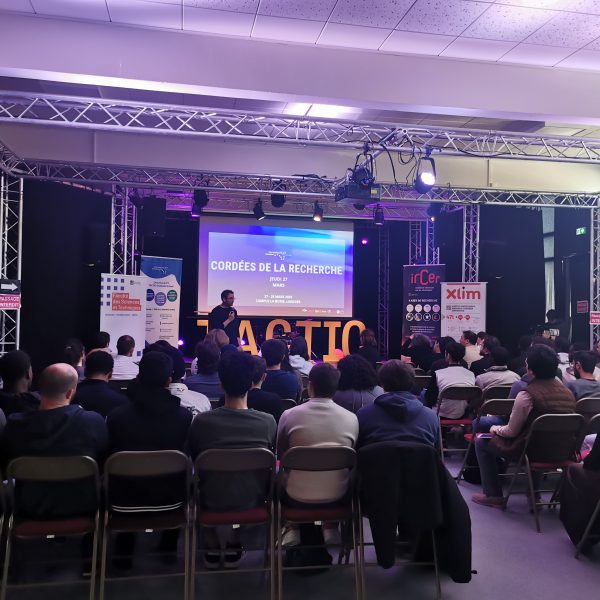
Workshop Research Climbing Rope – 2026 Edition
TACTIC Graduate School is organizing the Research Climbing Rope (Cordées de la Recherche) workshop on March 26 and 27, 2026, at CALM (Campus La Borie, Limoges).
This is an opportunity for our first-year Master’s students to present their research in poster format.
During these 2 days of workshops, there will be 4 conferences.
This event is open to all.
Discover the program and conference abstracts below.
Program
Thursday, March 26
11:15 a.m. – 11:30 a.m. | Greetings
11:30 a.m. – 12:30 p.m. | Conference by Manuella CERBELAUD (IRCER, University of Limoges)
“Ceramic Shaping by Colloidal Self-Assembly”
2:00 p.m. – 3:30 p.m. | Poster Session (6 posters)
-
“Characterization of a ferrite material for circularly polarized antenna applications”, Franqui Cabrel NANIYACK/Khalil GAHA. Supervisors: Vincent MUZZUPAPA/Laure HUITEMA
-
“Innovative imaging system for the direct observation of pheromone deposition by Lasius niger ants”, Kokou TOUDJI. PhD student: Erwan AMICHOT
-
“From system theory to reinforcement learning”, Thi Phuong Anh NGUYEN. PhD student: Quentin HELMAN
-
“Physics-driven neural networks for the modal characterization of optical fibers”, Amina MOKHTARI/Tiémoko DAGNOGO. PhD student: Siwar GHARBI
-
“Enhancing Techniques for Real-time molecular visualization”, Kim VAN RIJSWIJK. PhD student: Gabriel CADILHAC
-
“Intelligent WSN Node: From Real-World Power Measurements to Optimal Energy Strategy Simulation”, Aya TOUNSI/Olivier AKPLOGAN. PhD student: Yandi LIU
3:45 p.m. – 4:45 p.m. | Conference by Cédric EICHLER (INSA Centre Val-de-Loire)
“How to Build Your PET: Understanding and Defending Against Privacy Threats”
Friday, March 27
9:00 a.m. – 10:00 a.m. | Conference by Emmanuelle FRENOUX (Polytech Paris Saclay)
“Digital technology and the environmental emergency: understanding the issues, knowing how to act”
10:00 a.m. – 11:30 a.m. | Poster Session (6 posters)
-
“Study and design of a biosensor using opto-fluidic fibers”, Komla Jules ADZAVOTSE. Supervisors: Baptiste MOEGLEN PAGET/Georges HUMBERT
-
“Synthesis of silica glasses for the study of second harmonic generation in optical fibers”, Evgeniia GRZHESHCHUK/Samantha KOCH. PhD student: Thomas LARQUE
-
“Optimization of an opto-fluidic fiber probe for bio-detection using Raman spectroscopy for the detection of drug residues in water”, Bneta DEYE. Supervisor: Georges HUMBERT
-
“Informativeness and reliability of image models”, Houda HAJJAJ. PhD student: Ferdinand EQUILBEY
-
“Implementation of a noise radar and associated antenna system “, Sonia ZANNOU. PhD student: Jean-David BERTHAUX
-
“Morphological characterization and mechanical behavior of CMCs reinforced with functionalized bio-based fibers”, Oumaima EL BAZ/Benjamin MIMOUNI. PhD student: Thomas LAPORTE
1:00 p.m. – 2:30 p.m. | Poster Session (6 posters)
-
“Simulation of a vibrating reverberation chamber (VIRC)”, Ahmed HDIJI. PhD student: Quentin JACQUET
-
“Search for evidences of phase separation phenomenon in phosphotellurite glasses”, Matthieu DECLEMY/David SALZAT/Noé COTINEAU. PhD student: Noé MAURY
-
“Deep’nCars”, Wilfrid TOMENOU. PhD student: Giovanni ESTRADA
-
“Apport des grands modèles de Langages (LLM) appliqués à la sécurité dans les réseaux/Multi-LLM Systems for Edge Computing”, Mohamed Rami BOUAROUR. Supervisor: Karim TAMINE
-
“Measurements of the non-classical properties of light”, Karamoko DIALLO. PhD student: Iskander TILIOUINE
-
“Visual Search in Virtual Reality”, Gabriel JARDIN. PhD student: Rivo Andriamanalina
2:30 p.m. – 3:30 p.m. | Conference by Thomas FROMENTÈZE (XLIM, Université de Limoges)
“Emergent materials and devices without blueprints”
3:45 p.m. – 5:15 p.m. | Poster Session (6 posters)
-
“SSub-THz Radiating Surfaces”, Loïc TCHATCHOUANG NJINMO /Yasmine LAHLOU. Supervisors: Cyril DECROZE/Aurelian CRUNTEANU/Georges HUMBERT
-
“Production of porous phyllosilicate ceramics shaped by strip casting – freezing: Effect of incorporating peanut shells”, Otmane CHAKIR/Sanae SABER/Idir ALICHE. PhD student: Iffat Qoudsiyyah MAURY NJOYA
-
“Side-channels attacks on code-based cryptography ‘HQC'”, Cheikh Omar LY. Supervisor: Nicolas ARAGON
-
“Synthesis of electrode materials suitable for strip casting for fuel cells and electrolyzers”, Yassin HAOUAS/Nadège N’DRI. PhD student: Maryus FAURE
-
“Leveraging Language to Improve Visual Image Quality Assessment”, Belvanie Junelle TCHETCHOUA TENE. PhD student: Aymen SEKHRI
-
“Development of a “Spectral Mismatch Correction Toolbox” for the accurate metrology of emerging photovoltaic cells”, Hiba SLAOUI /Pélagie TSAKPO. PhD student: Camille FROUIN
Conference by Manuella CERBELAUD | “Ceramic Shaping by Colloidal Self-Assembly”
Due to their properties, ceramics find applications in numerous fields such as medicine, energy, aerospace, and more. These applications increasingly require devices in which ceramics can have complex shapes and structures, necessitating the development of specific shaping processes. Most current processes are colloidal, meaning they use stable suspensions. The behavior of these suspensions is crucial for the success of the process, which is why many studies focus on the formulation of these raw materials, often obtained using polymer additives.
Breaking with this concept, for several years at IRCER, we have been studying the possibility of shaping ceramics using colloidal self-assembly, and in particular, heteroaggregation. This presentation will demonstrate how a strategy based on both experiments and numerical simulations at the colloid scale can lead to the development of new ceramic shaping processes.
Bio
Manuella Cerbelaud has been a CNRS research fellow since 2010. Her research aims to better understand the behavior of colloidal suspensions in order to improve existing ceramic shaping processes or to develop new ones. The originality of her work lies in the connections she establishes between experimental characterizations and the numerical simulations she develops.
She received her engineering degree from the École Nationale Supérieure de Céramique Industrielle (ENSCI) in 2005 and then obtained her doctorate in 2008 through a joint doctoral program between the Universities of Limoges and Genoa. In 2010, she became a CNRS research fellow at the Jean Rouxel Institute (IMN) in Nantes, where she studied inks used for shaping electrodes for lithium batteries. Then in 2014, she joined IRCER, where she works in the research area on innovative ceramic processes.
Conference by Cédric EICHLER | “How to Build Your PET: Understanding and Defending Against Privacy Threats”
In this talk, we’ll explore the hidden ways personal data can be exposed, even when it’s never been directly share.We will start by exploring common privacy threats, such as re-identification and attribute inference attacks, and why they matter.
Next, we’ll introduce Privacy Enhancing Technologies (PETs) and discuss popular countermeasures and anonymization models. We’ll see how these defenses work in practice, and how they affect utility.
Finally, we’ll discuss how the success of privacy attacks and defenses is measured. We’ll highlight pitfalls in evaluation and utility metrics, and how to avoid them. Using a concrete example, we’ll connect high-level privacy principles to real-world design choice.
Bio
Cédric Eichler obtained his Ph.D. from Toulouse III in 2015. Since 2016 he is associate professor at INSA Centre Val de Loire, where he developed his interest for both technical and legal aspects of privacy. He is currently a member of the PETSCRAFT Inria team. He was Data Protection Officer of INSA Centre Val de Loire from 2018 to 2022 and head of the “Security of Data and Systems” research team from 2017 to 2022. His current research focuses on large language models as both a privacy threat and a tool for defense.
Conference by Emmanuelle FRENOUX | “Digital technology and the environmental emergency: understanding the issues, knowing how to act”
In a world where digital technology is ubiquitous and the use of artificial intelligence is presented as essential, we will examine the very tangible environmental impacts of the cloud and digital technology in general. Through an analysis of the different phases of the hardware lifecycle, we will also explore the levers we have at our disposal to reduce the impact of our equipment and our usage.
Bio
Emmanuelle Frenoux is an Assistant professor in Computer Science at Polytech Paris Saclay. After completing her PhD in medical image processing, she became interested in the various applications of AI to image processing more generally, and then in the environmental impact of digital technology. As such, she has been a member of the CNRS EcoInfo research group for several years.
Conference by Thomas FROMENTÈZE | “Emergent materials and devices without blueprints”
In nature, certain complex structures perform highly specific functions without any global blueprint guiding their formation. Structural colors in butterfly wings, the strength of bones, and the organization of biological tissues emerge simply from local interactions. In this presentation, I will show how such mechanisms can inspire a different way of designing materials and devices. The idea is to replace heavy, centralized optimization with generative models capable of spontaneously producing useful physical properties. Initial applications include metasurface antennas, wave guiding, advanced imaging, and non-destructive evaluation. I will also show how this approach has already been successfully transferred to continuum mechanics, opening promising perspectives for extension to other areas of physics.
Bio
Thomas Fromentèze is an Associate Professor with Habilitation at the University of Limoges. He teaches in the Mechanical Engineering Department of the IUT du Limousin and conducts his research at the XLIM Research Institute. Since 2025, he has held a Junior Fundamental Chair at the Institut Universitaire de France. In 2015, he was a postdoctoral researcher at Duke University (USA) in the group of David R. Smith, where he has been an adjunct member since 2016. His research focuses on the development of computational imaging methods in the radio-frequency domain and on the design of generative models for physics and engineering inspired by biological morphogenesis.