
International mobility – Internship in Canada
This summer, discover each week the portrait of our M1 students who are currently on international mobility.
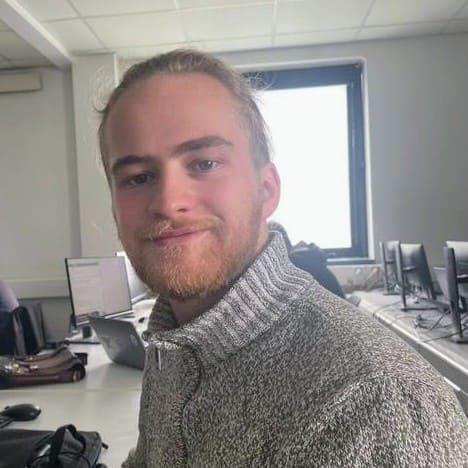
Today it is Alexeï, student in the Software Design and Development program, who is doing his internship at the Ecole de technologie supérieure, Montréal (Canada).
1. What is your background?
My name is Alexei and I am a Master 1 student in Software Design and Development. Before this Master’s degree, I completed a Bachelor’s degree in Computer Science at the University of Poitiers.
2. International exchange is mandatory during the first-year Master’s program in TACTIC Grad School. Were you apprehensive about this exchange?
Yes, a little. It’s always daunting to go abroad, especially when you know you’ll have to quickly adapt to a new environment, a new culture, and sometimes a different way of working. But I also saw this mobility as an opportunity to step out of my comfort zone, to progress technically and personally, and to have a unique experience.
3. How did the internship search go, and how did you choose your internship location?
I focused my research on labs or research teams working on topics close to my interests, such as physics-based rendering and neural networks. The choice of location was based on recommendations from my research tutors, available supervisors, and the opportunity to experience a new culture while maintaining a good work-life balance.
4. What is the topic of your internship?
I’m working on a topic at the intersection of artificial intelligence and image synthesis. The goal is to train a model based on neural networks to learn how to reproduce complex random behaviors. More specifically, I’m developing a tool capable of generating random numbers based on very specific probability laws. This type of technology is used in fields such as special effects in cinema, realistic video games, and even light simulation in 3D scenes (for example, to design photorealistic lighting). The goal is to efficiently sample the right areas of the image, i.e., to concentrate the calculations where they are most important to achieve faster and more accurate rendering.
5. How is the internship going overall? Integration with the on-site teams, etc.
The internship is going very well. It’s intellectually demanding work, but also very educational. I have the opportunity to design model architectures, train them, critically analyze them, and improve them to achieve sufficient accuracy. I’m also learning to better structure my code, document my experiments, and carefully evaluate the performance of my models.
6. What are your responsibilities and what does a typical day of your internship looks like?
My missions consist of developing neural models in Python, generating synthetic datasets, training my models on these data, and evaluating their quality. I also work on integrating these methods into existing tools, for which I rely on reading recent research articles to improve my approaches.
7. A travel story to share? Any culture shock there?
In Montreal, I was immediately struck by the kindness and warmth of the people—everyone is very welcoming, whether during the internship or in everyday life.
As for culture shock, I didn’t expect the importance of the tip. During my very first restaurant meal, I paid the bill without leaving one, thinking that, like in France, service was included. The server, also from France, kindly explained to me that tipping wasn’t mandatory, but that it was rude not to.
At the time, it was a little disconcerting, but I quickly realized that it was an important social norm in Quebec. Since then, I’ve been much more careful! This kind of experience forces you to adapt quickly to cultural differences, even in small everyday gestures.
8. What advice would you give to future students who are going on their exchange program?
I would say: prepare to step out of your comfort zone, but in the best possible way. Choose an internship you’re truly passionate about—it makes all the difference. Research the organization you’re applying for, plan ahead for the administrative procedures, and above all, stay open and curious. It’s a unique opportunity to learn differently, to progress, and to meet people who share your passion.