Common days 03 and 04 February 2022
A project made in Ceramics and ICT Graduate School : the Cordées de la Recherche
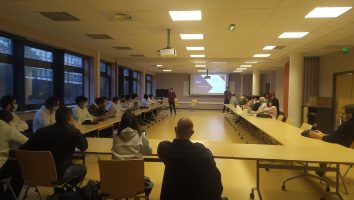
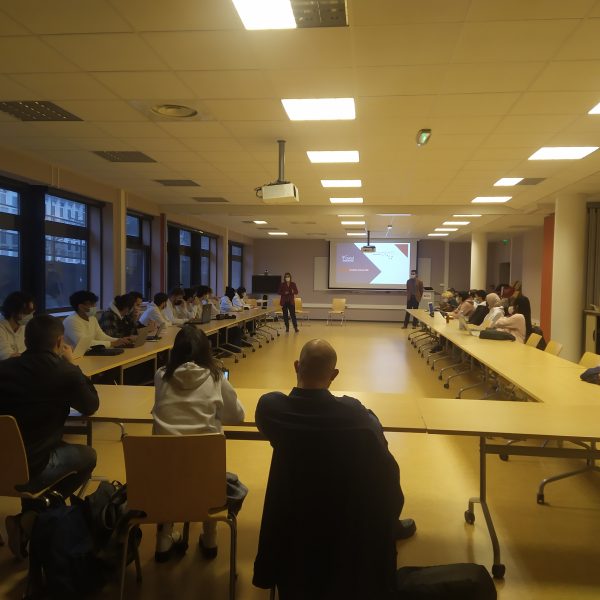
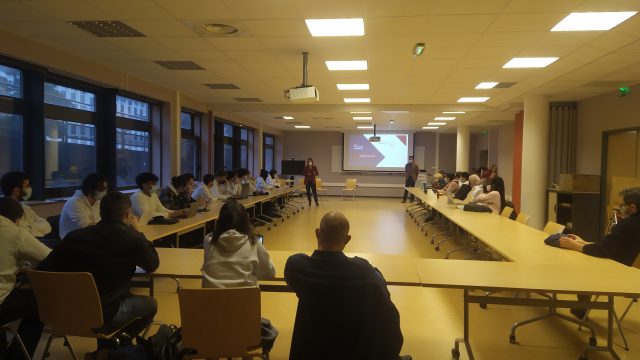
After the last Cordées 2020/2021, which took place remotely, the Ceramics and ICT graduate school students met on the campus of La Borie in Limoges to present their work during the second edition of the Cordées, on February 3, 2022.
What is a “cordée de la recherche”?
A “cordée de la recherche” brings together around a scientific project:
-A Master’s student from the Ceramics & ICT – Graduate School,
– A doctoral student from the XLIM (UMR CNRS 7252) or IRCER (UMR CNRS 7315) research laboratories at the University of Limoges or Poitiers,
– The team supervising the doctoral student.
The Master’s student is guided in his or her initiation to research by the doctoral student with the support of his or her supervisory team, which helps to define the trajectory of the research project. This program is supported by the Doctoral Schools ED 610 SISMI “Sciences and Engineering of Information, Mathematics” and ED 609 SIMME “Sciences and Engineering of Materials, Mechanics, and Energy” of the Confederal University of Léonard de Vinci, which will become from September 2022 :
– SI “Sciences and Engineering” at the University of Limoges
– MIMME “Mathematics, Computer Science, Materials, Mechanics and Energy” within the University of Poitiers.
What are the objectives?
The student of the Ceramics & ICT Graduate School has access to the state-of-the-art equipment of the XLIM and IRCER laboratories, puts into practice the methodologies and theories learned in the more traditional courses, contributes to the progress of the thesis by being assigned to develop a related experiment or explore a new idea, learns how to present scientific results in the standards of conferences…
The doctoral student is trained in supervision, a skill that he or she will be able to use in his or her job search, by defining the trainee’s action plan in agreement with his or her supervisory team, by accompanying the trainee in carrying out his or her experimental and/or numerical work, by helping him or her to analyze his or her scientific results and to construct a presentation of the work done.
How does the activity take place?
The doctoral student, with the agreement of his or her supervisory team, defines a problem within the scope of his or her thesis. In order to deal with it, the Master’s student is immersed in the research team for at least half a day a week during the academic year.
Two major reporting events in the form of poster sessions and oral presentations by the student/doctoral researcher punctuate the work of the research teams and provide an opportunity for scientific exchanges between all the stakeholders of the EUR research teams and the XLIM and IRCER researchers involved in the project or not.
Some thirty students, as many doctoral students and thesis directors were involved in these “cordées” again this year, which contribute to the development of skills through action, promote scientific exchanges and the networking of young people with research actors!
A day like a conference
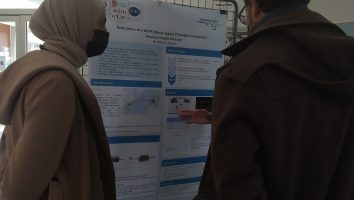
During this day, the master 1 students present their scientific posters, halfway through the course, in front of the doctoral students. The goal is to train them for a real scientific poster session. The presentation of their work is in english, allowing them to work on their oral fluency.
It is also an opportunity for everyone to get together. The students from Poitiers met with their counterparts from Limoges for the day. It is the moment to share the lunch and to discover the work of their classmates. Some teachers from Poitiers came to see the progress of their students.
The feedback from the students on this day is promising, one student declares: “I really liked this new experience of the poster presentation, it was great to have an idea on the other projects and the other interdisciplinary specialties. At the beginning we were a little bit stressed but then everything went well. It was very interesting, it will be an added value for us. It was a pleasure to attend this event.”
What’s next …
They will meet again on April 07 and 08, 2022 for the final presentation of their work with their PhD referents. Thus, they will be able to develop orally the experiments that they will have done in the framework of their project. For the doctoral students, this will be the moment to support the interest of the student’s work on their research.
Until then, students have time to continue and deepen their work before leaving for their internship.
A morning of discovery
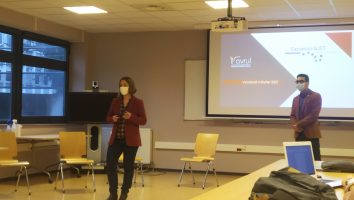
The day of February 04 began with a conference given by AVRUL (Agency for the Valorization of Research), the PEC (European Ceramics Cluster) and Alpha-RLH, a competitiveness cluster. The students were able to discover and understand the ecosystem that surrounds them and see the link between research and industry. This allows them to have knowledge on the possibilities to undertake or to be part of a project around the theme of their training.
Then two startup entrepreneurs, Michael Lesvigne from the startup Biopythos and Rémi Farges from the company GAT, came to tell their entrepreneurial experiences in two different fields around their engineering background. The students were able to see more concretely that it is possible to be an entrepreneur with a specific scientific training. The majority of the class would like to go on to a thesis rather than to entrepreneurship. Nevertheless, they will have the keys to start a project if they wish. This intervention complements well the courses of Mr Acquatella, whom they will join in the afternoon.
The next common days will take place on March 08 and 09 with notably the discovery of the industrial property with Laeticia Canezza of the company Ines-PI, and the visit of the center of transfer of ceramic technologies, CTTC.