Toxicology and environmental health
|
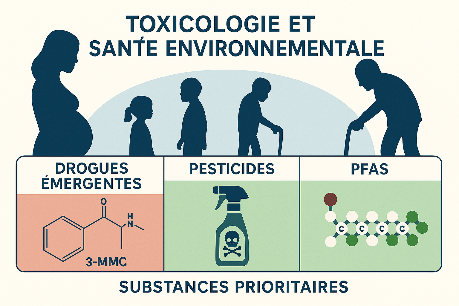
This research area focuses on the effects of environmental exposures on human health, particularly during periods of physiological vulnerability (such as after transplantation, in cases of chronic disease, during pregnancy, and in childhood). The team studies priority substances such as pesticides, PFAS, and emerging drugs (e.g., 3-MMC), which are often persistent, bio accumulative, or poorly characterized.
|
 |
To address these challenges, we combine cutting-edge approaches ranging from cellular experimentation (human cell lines, organs-on-a-chip) to toxic kinetic and predictive modelling, including the development of innovative analytical methods tailored to a wide variety of matrices and multiple contexts to answer the research questions (LC-MS/MS, GC-MS/MS, HRMS, soft ionization).
Our program is structured around clinical and population-based projects (exposure and/or co-exposure to pyrethroids, glyphosate, PFAS, NPS, etc.), international collaborations (perinatal exposure in Senegal), and sustained translational research in partnership with hospitals. This interdisciplinary field aligns with public health priorities and the “One Health” approach championed by the University of Limoges, which integrates human health, environmental quality, and technological innovation.
Souleiman El Balkhi
Project manager
Franck Sanit-Marcoux
Project manager

Nicolas Védrenne
Project manager
PFAS are persistent chemical pollutants found in many everyday consumer products, such as food packaging, textiles, and cosmetics. This project aims to characterize the mechanisms by which these substances cross the placental barrier. By combining human cell models, in silico modelling tools, and analytical approaches, it provides a better understanding of the factors influencing the placental permeability of these compounds. The goal is to prioritize the substances of greatest concern for maternal-foetal health by providing data useful for the regulation and assessment of chemical risk during pregnancy.
We study the metabolic transformation of synthetic drugs frequently found in seizures. Using mass spectrometry, we identify their major metabolites, assess their toxicity in human liver and kidney models, and study the interactions between these new synthetic substances (NPS) and the main psychotropic drugs consumed by drug users. This project helps improve our understanding of the health effects of NPS and anticipate the risks associated with their use. Our initial work focused on 3-MMC.
The goal is to better understand the interactions between the organs involved in drug metabolism and elimination, particularly in the context of transplantation. By developing approaches that combine in vitro modeling (organs-on-a-chip, dynamic co-cultures) and pharmacological characterization, this project seeks to decipher the mechanisms of remote effects induced by immunosuppressants, in order to optimize their use and reduce adverse effects.
This project assesses the risks associated with pesticides during periods of vulnerability, such as pregnancy, by combining human exposure studies (workers, pregnant women, the general population) with mechanistic approaches. It includes the MeriPoPyNs study (150 mother-child pairs) and a thesis co-supervised with Cheikh Anta Diop University (Senegal) on neonatal exposure. Two population-based studies were also conducted: VESTAL (300 hospital staff at Limoges University Hospital) and an MSA survey on glyphosate (700 adults in the Limousin region). All of this research is supported by a reference analytical platform, recognized as an LBMR since 2021 for the detection of pesticides in biological matrices, equipped with LC-MS/MS, GC-MS/MS, and HRMS.
This project aims to develop and validate next-generation analytical tools for application in clinical, environmental, and forensic toxicology. Thanks to industrial partnerships, the laboratory holds the status of an innovation centre and is equipped with state-of-the-art analytical instruments (LC-HR/MS, Q-TOF, PESI-MS, and the CLAM 2030 automated extraction system). Four doctoral theses have been completed over the years, with the following objectives: the creation of a database of high-resolution spectra; evaluating direct ionization techniques (PESI) suitable for very small sample volumes; and developing methods combining soft ionization and supercritical fluid chromatography. These tools are applied in numerous projects and even in routine hospital toxicology, forensic, or occupational settings.